Artist bio
Title
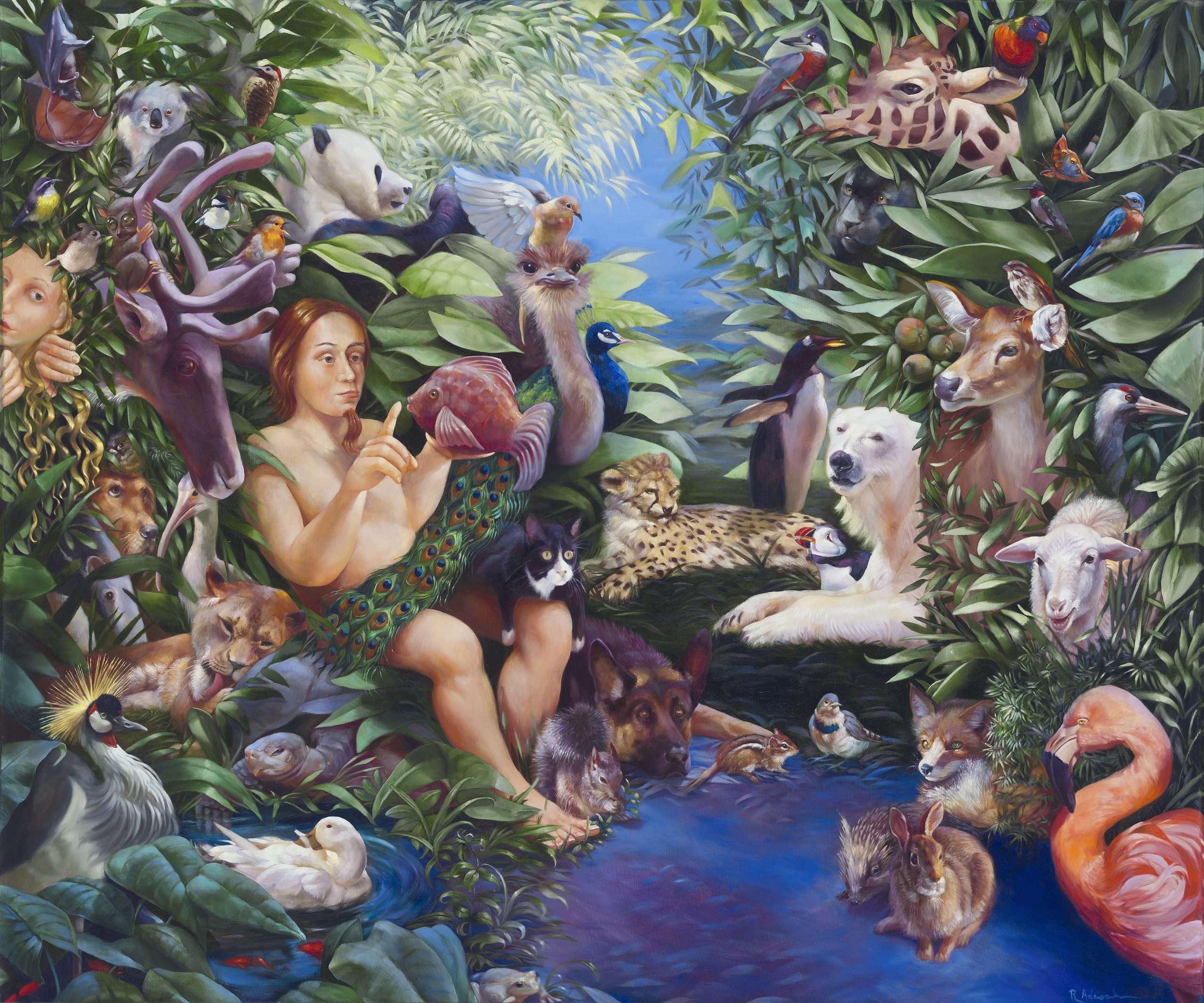
Adam Naming the Animals & the Appearance of Eve
Medium/Genre
PaintingArtist Statement
My paintings are generally from large to monumental format. The largest ones at 7' height were begun with simple composition lines that cross the entire surface. Within those general lines, I gradually add marks with very thin paint where animals or people will be placed, building around a structured composition that I know will gently carry the viewer's eye across the whole canvas.
Some of the other compositions, especially if they are highly detailed, are built with an organized symmetry after I have mapped out a grid of 1-foot sections on the blank canvas. Next, I will use major lines to define the general composition, building people and animals within the lines as I go.
I intentionally use strong color, planning color and highlights to carry the viewer to what is most important in the painting. I also repeat the use of certain colors to create patterns that accomplish the same thing.
Gradually, I add smaller elements, details in clothing, and other fine detail such as highlights on hair or animal whiskers, but that isn't until the painting is nearly completed.
Lastly, as I begin any painting, I do what I consider the most important, which is to study the biblical text for a deeper understanding of what God wants to communicate through His word, both in a general sense, and a broader sense of where the story fits within the biblical narrative. The Old Testament points forward to Jesus, the New Testament points back to Him. As I work, I am very aware of my dependence on His Holy Spirit to inspire, to instruct, and to guide as I communicate His word using the vehicle of visual imagery.
How it fits into contest
In the beginning, God created the heavens and the earth. Then God said, “Let Us make man in Our image, according to Our likeness; and let them rule over the fish of the sea and over the birds of the sky and over the cattle and over all the earth, and over every creeping thing that creeps on the earth.” God created man in His own image, in the image of God He created him; male and female He created them. And out of the ground the Lord God formed every beast of the field and every bird of the sky and brought them to the man to see what he would call them; and whatever the man called a living creature, that was its name. Genesis 1:1,26-27; 2:19-20
In the beginning, God created everything that exists in 6 days, and declared the creation “Good.” After God created Adam, he gave him the task of naming all the animals, but God saw the man had no suitable companion. For the first time, God called it “not good” for Adam to be alone. It was at this time God made Eve and brought her to Adam.
The generations that were recorded in the Bible began with this first man, Adam and his wife, Eve. In the Book of Luke, Chapter 3, Luke traces the generations before Jesus all the way back to Adam, the son of God. In this painting Adam is choosing a name for his fish while Eve peers out of the branches to get a first glimpse of her new husband.
How to Purchase this Artwork
Adam Naming the Animals and the Appearance of Eve, oil, 60 x 72 $24,000
https://www.rosemarieadcock.com/workszoom/769288/adam-naming-animals-and-the-appearance-of-eve#
https://ChapelGalleries.com
Other Goods & Services Available from this Artist
We carry products and gifts such as puzzles and other reproductions of the paintings at our https://ChapelGalleries.com website. We use proceeds from these to help the work of Arts for Relief and Missions (ARM), our tax-exempt charitable organization, where we focus on our humanitarian work (currently for widows in Uganda), as well as building our Chapel Galleries marketplace church-plant ministry.
View more art from around the world
Submit Your Artwork Today!
The 2026 Engage Art Contest will be accepting new artwork in January 2026!